
1. Major vs. Minor Markets / Instruments (Most Common Usage)
This refers to the liquidity of different financial instruments based on their trading volume and ease of transaction.
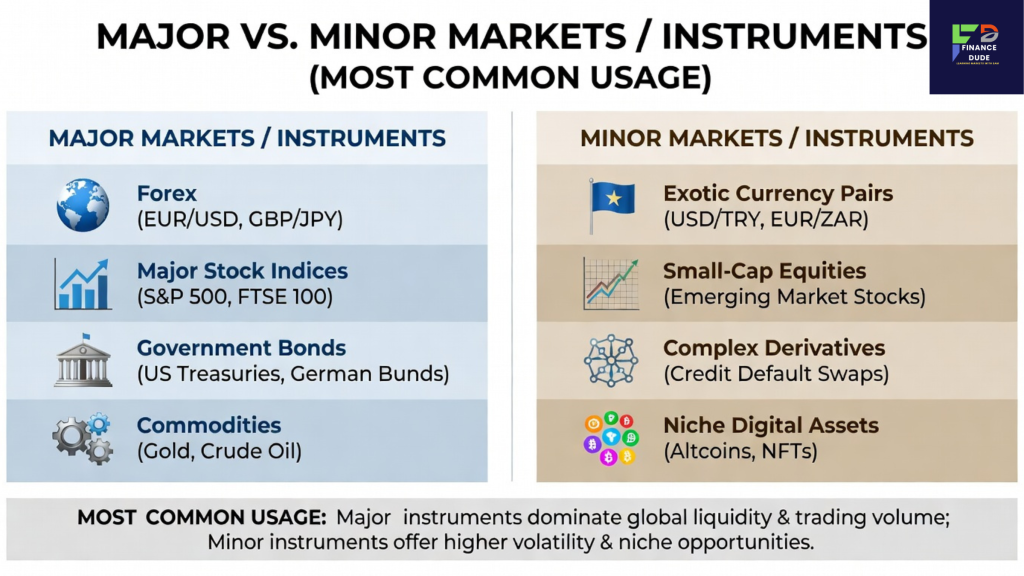
Major Liquidity:
- Refers to: Highly traded, deep markets where large volumes can be traded with minimal impact on price.
- Characteristics: High trading volume, tight bid-ask spreads, many active buyers and sellers, high market depth.
- Examples:
- Forex: Major currency pairs (EUR/USD, USD/JPY, GBP/USD, USD/CHF, AUD/USD, USD/CAD, NZD/USD).
- Equities: Large-cap stocks in major indices (Apple, Microsoft, etc.), major stock indices futures (S&P 500 E-mini).
- Bonds: U.S. Treasury bonds (especially the 10-year note), German Bunds.
- Commodities: Crude Oil (WTI, Brent), Gold.
Minor Liquidity (also called “Illiquid” or “Thin” Markets):
- Refers to: Markets with lower trading volume where transactions can significantly move the price.
- Characteristics: Wider bid-ask spreads, fewer participants, low market depth, higher volatility from single trades.
- Examples:
- Forex: Minor (or cross) currency pairs (EUR/GBP, AUD/NZD) and exotic pairs (USD/TRY, EUR/PLN).
- Equities: Small-cap stocks, micro-caps, stocks on minor exchanges.
- Bonds: Corporate bonds from small issuers, municipal bonds.
- Other: Penny stocks, certain derivatives, real estate, collectibles.
Key Takeaway: A “major” market is inherently more liquid. Trading in a minor/illiquid market carries liquidity risk—the risk of not being able to buy or sell quickly at a fair price.
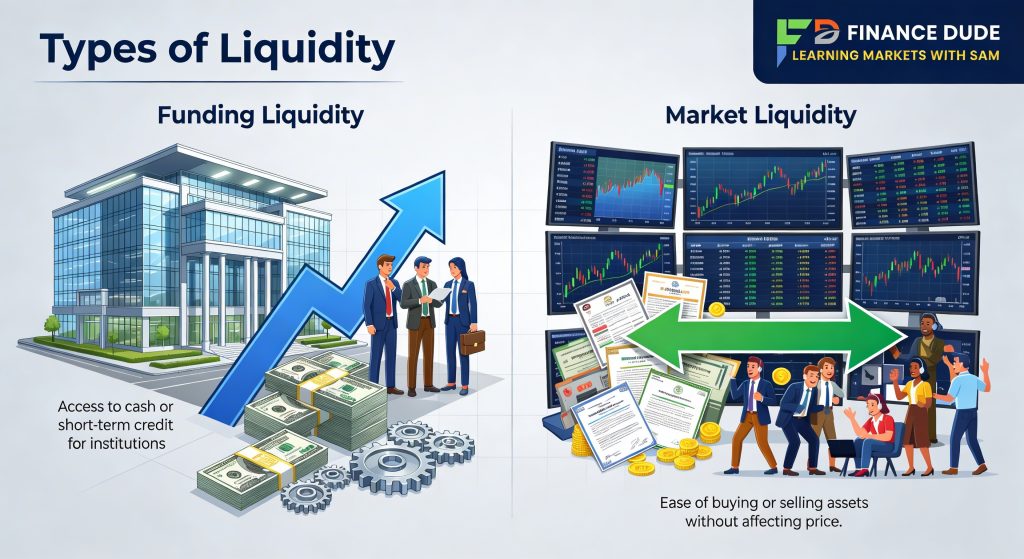
2. Types of Liquidity: Funding Liquidity vs. Market Liquidity
This is a more technical distinction used in corporate finance and risk management.
Major Liquidity (often called Funding Liquidity or Accounting Liquidity):
- Refers to: The ease with which a company or entity can meet its short-term financial obligations using its liquid assets.
- Focus: Cash flow and balance sheet strength.
- Key Question: “Can this company pay its bills as they come due?”
- Measures: Current Ratio, Quick Ratio, Cash Ratio, Operating Cash Flow.
Minor Liquidity (often called Market Liquidity):
- Refers to: The ease with which an asset can be converted into cash in the market without affecting its price (as described in section 1 above).
- Focus: Market microstructure and transaction ease.
- Key Question: “Can I sell this asset quickly at a price close to its last quoted market value?”
- Measures: Bid-Ask Spread, Trading Volume, Market Depth.
The Critical Link Between the Two Concepts
The two concepts are deeply interconnected, especially during a crisis:
- A company might hold assets it considers liquid (like corporate bonds), but if a market-wide shock hits (market liquidity dries up), those assets can become hard to sell.
- If the company cannot sell those assets, it may fail to raise cash, leading to a funding liquidity crisis (inability to pay debts).
- This vicious cycle is known as a “liquidity spiral” and was a central feature of the 2008 Financial Crisis.
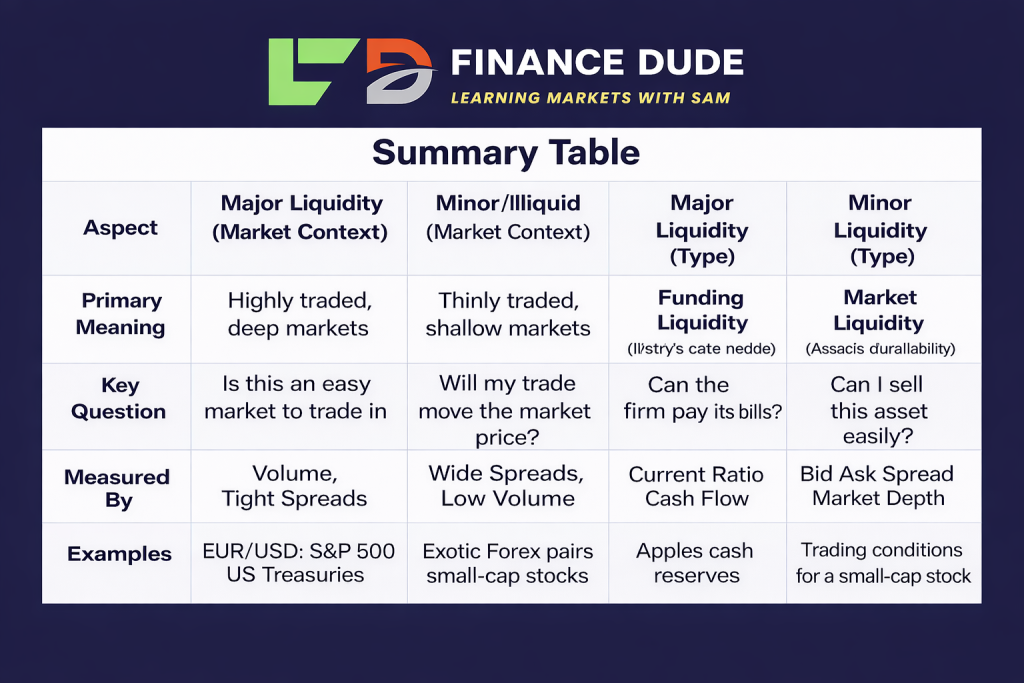
In conclusion:
- If you’re talking about trading, you’re likely referring to major vs. minor markets.
- If you’re analyzing a company’s financial health, you’re likely distinguishing between funding (major) and market (minor) liquidity as interconnected risk types.
Understanding both frameworks is crucial for comprehensive risk management and investment analysis.